The Department of Homeland Security has raised I-9 fines to nearly $30,000 per violation, with ICE already issuing more than 5,200 audit notices in 2025. For large employers hiring at scale, even a modest error rate can result in multimillion-dollar penalties, reputational damage, and executive liability.
Organizations are responding by replacing error-prone, manual checks with advanced technology platforms like Lightico that provide automated document verification, real-time error detection and comprehensive audit trails to mitigate the risk of costly violations in this heightened enforcement environment.
I-9 Enforcement Escelates with Record Fines and Nationwide Inspections
In January 2025, the Department of Homeland Security announced the latest round of I-9 fine increases, with penalties now reaching up to $28,619 per violation for knowingly employing unauthorized workers. This represents a significant escalation in enforcement pressure that coincides with aggressive workplace inspection campaigns targeting large employers across the United States.
The enforcement landscape has intensified dramatically. Recent reporting shows that ICE inspections can be a precursor to workplace raids and have recently been used by the Trump administration as a method for detaining undocumented workers without judicial warrants. Meanwhile, ICE has delivered more than 5,200 I-9 audit notices to businesses in a two-phase nationwide operation as of February 2025.
For America's largest employers, this represents an existential compliance risk that grows with every hire.
The Real Cost of I-9 Violations for the Largest Employers
For America's largest employers, the scale of hiring is staggering. Retailers, restaurant chains, logistics giants, and e-commerce leaders can hire tens of thousands of employees each month across hundreds or even thousands of locations. Each new hire requires a completed and compliant Form I-9. Every single mistake—whether it's a missing signature, incorrect date, or expired ID carries a financial penalty.
The math is brutal. On January 2, 2025, DHS announced new civil penalties for Form I-9 violations, with increased fines on employers for failure to comply with I-9 regulations: I-9 paperwork violations increased from $288 to $2,861 per Form I-9 violation. For knowingly employing unauthorized workers, fines can reach up to $28,619 per violation.
For an employer onboarding 50,000 workers annually, even a conservative 10% error rate at $2,500 per violation equals $12.5 million in potential fines. That doesn't include repeat offense penalties, legal fees, remediation costs, or brand damage from public enforcement actions.
Critical Alert: ICE issued more than 5,200 Notices of Inspection to businesses nationwide in 2024 as part of a two-phase audit surge targeting high-volume employers.
Large organizations with dispersed HR processes and seasonal hiring spikes are prime targets because the sheer volume of paperwork makes errors statistically inevitable without airtight controls. For enterprise compliance leaders, the risk isn't theoretical, it's a multimillion-dollar exposure that can be triggered by routine hiring activity.
Why I-9 Compliance Gets Risky at Scale
Volume Creates Vulnerability
Large employers regularly onboard thousands of employees annually, with volume spiking during seasonal peaks. Each hire triggers multiple compliance requirements including federal Form I-9, state-specific tax forms, and background check consents. At this scale, even a 5-10% error rate can translate into millions in potential fines.
Multi-State Complexity Multiplies Risk
While Form I-9 is a federal requirement, states may impose additional employment eligibility verification obligations. These can include:
- Different retention periods
- Supplementary forms
- Unique disclosure requirements
- Varying electronic signature standards
Managing these variations manually across hundreds of locations increases the risk of inconsistency and omission.
Fragmented Systems Create Gaps
Paper forms, emailed PDFs, and separate systems for eSignatures, document storage, and audit tracking create compliance gaps. Missing pages, incomplete fields, and expired IDs are common audit failures in such environments.
Enforcement Activity Reaches Record Highs
ICE has dramatically increased employment eligibility verification enforcement throughout 2025. As reported by The Washington Post in June 2025, the Trump administration has instituted quotas for ICE's immigration crackdown on employers, with inspections serving as precursors to workplace raids. Employment law experts confirm that audit activity is up significantly, and high-volume employers are now priority targets because the probability of violations increases with hiring scale.
What Happens When I-9 Compliance Fails
Financial Penalties Are Severe
According to the January 2025 DHS penalty updates, current fines include:
- I-9 paperwork violations: $288 to $2,861 per form (increased from previous $281-$2,789 range)
- Substantive violations: Similar range for uncorrected technical errors
- Knowingly employing unauthorized workers: Up to $28,619 per violation
Current Enforcement Climate Escalates Risk
Recent reporting from July 2025 shows that ICE is arresting migrants in worksite raids with Trump administration officials focusing workplace raids on businesses as part of ramped-up enforcement. NPR reported in February 2025 that businesses are bracing for immigration-related workplace raids, with companies that employ people without legal status on heightened notice.
The Denver enforcement action that resulted in $8 million in combined penalties demonstrates the scale of financial exposure. One business received $6.2 million in fines after ICE found 100% substantive violations and determined the company knowingly employed at least 87 unauthorized workers.
Similar cases across industries show that no sector is immune from aggressive enforcement. As noted by the California Chamber of Commerce in May 2025, workplace raids and I-9 audits have become standard enforcement tools requiring immediate employer preparation.
Audit Response Timeline Is Unforgiving
3 Business Days: Once an employer receives a Notice of Inspection, there are just three business days to present all I-9 documentation.
This deadline forces HR teams to halt regular operations, comb through records, correct errors, and prepare responses under intense time pressure.
Reputational Damage Extends Beyond Fines
Enforcement actions are public record and often reported in the media. Large fines can harm recruitment efforts, partner relationships, and customer trust. In extreme cases involving patterns of violations, senior executives may face criminal liability under federal immigration law.
I-9 Inspection Process
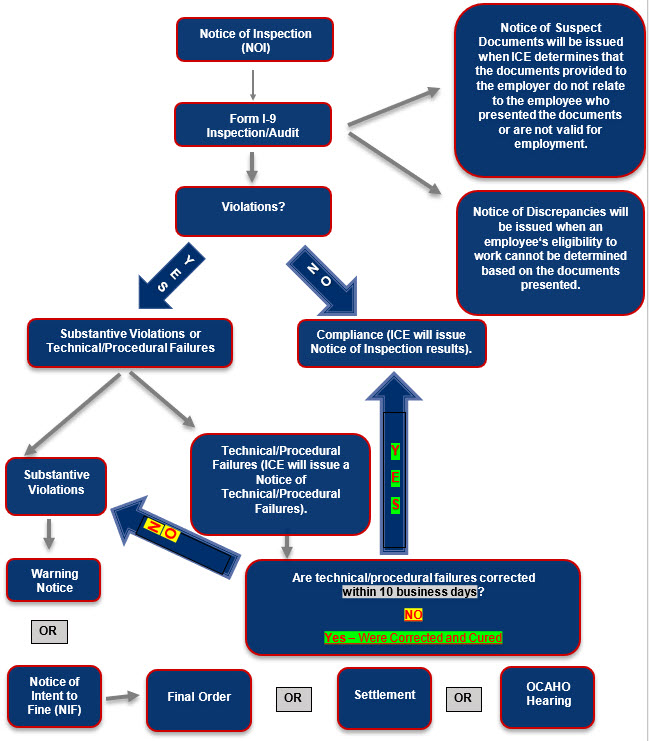
Source: ICE
The Modern Solution: Technology-Driven Compliance
Leading employers have moved beyond reactive compliance to proactive prevention through comprehensive technology platforms. Rather than relying on manual checks or managing multiple disconnected systems, forward-thinking organizations are consolidating their entire hiring compliance process into unified solutions that eliminate gaps and ensure accuracy from day one.
How Lightico Transforms Enterprise I-9 Compliance
Lightico's AI-powered compliance platform addresses every challenge large employers face with I-9 management. Here's why it's the smarter way to handle I-9, E-Verify and ID verification in high-volume hiring:
Complete Form Management:
- Pre-built I-9, W-4, and state-specific form templates ensure USCIS compliance
- Auto-validation prevents common completion errors by checking every field before submission
- Mobile-first design allows candidates to complete all forms in minutes from any device
Advanced Document Verification:
- AI-powered processing extracts and validates data from IDs, SSNs, and work permits instantly
- Automatic classification analyzes "authorization to work" documents per USCIS Lists A, B, and C
- Real-time fraud detection identifies tampered or altered documents before approval
Streamlined Workflow Management:
- No-code platform lets HR teams adapt workflows without IT involvement
- Secure eSignature collection for background checks, policy disclosures, and agreements
- Automated alerts flag upcoming document expirations and compliance deadlines
Enterprise-Grade Oversight:
- Track compliance status across all locations
- Complete audit trails with time-stamped documentation for every action
- Role-based access controls protect sensitive employee information
Case Study: Restaurant Chain Eliminates I-9 Compliance Risk
The Challenge: A national restaurant chain with over 300 branches struggled with incomplete I-9s, slow seasonal onboarding, and poor compliance visibility across locations. A spot audit revealed 12% of forms contained errors, representing millions in potential liability.
The Lightico Solution: The retailer implemented Lightico's no-code compliance journey platform to replace their fragmented manual processes with a unified digital system.
Measurable Results:
- 100% I-9 completion achieved before every start date
- 40% reduction in onboarding time during peak hiring seasons
- Zero fraud incidents through real-time document verification
- Complete audit readiness maintained year-round
- Zero violations in all subsequent compliance reviews
Why Enterprise HR Teams Choose Lightico
Proven at Scale: Trusted by America's largest employers for mission-critical compliance
Rapid Implementation: Full deployment in weeks, not months, with seamless system integration or standalone deployment
Risk Elimination: Prevents compliance penalties, blocks fraudulent documents and reduces legal exposure
Unified Platform: Consolidates multiple disconnected tools into one comprehensive solution
Enterprise Security: SaaS solution with enterprise-grade security and complete auditability
Implementation Roadmap for Large Employers
Phase 1: Assessment (Week 1)
- Audit current I-9 completion rates across all locations
- Calculate potential penalty exposure based on hiring volume
- Identify state-specific employment eligibility verification requirements
- Assess integration needs with existing HR systems
Phase 2: Platform Selection (Weeks 2-3)
- Verify AI-powered document validation capabilities
- Confirm mobile accessibility for remote and distributed hiring
- Validate comprehensive audit trail and compliance documentation features
Phase 3: Deployment (Weeks 4-6)
- Configure workflows and integrate with existing HRIS/ATS systems
- Train HR staff on new digital processes and validation procedures
- Establish compliance monitoring procedures and alert protocols
- Create incident response protocols for potential violations
Phase 4: Optimization (Ongoing)
- Monitor compliance metrics and system performance
- Schedule periodic compliance reviews and system updates
- Refine workflows based on regulatory changes and business needs
- Scale platform usage across additional locations and hiring functions
Conclusion: The Strategic Imperative
I-9 compliance has evolved from a routine HR task into a high-stakes business imperative. For large employers, the combination of record-high penalties, aggressive enforcement, and complex multi-state requirements makes manual or fragmented processes an unacceptable liability. The current enforcement climate leaves no margin for error. With fines reaching nearly $30,000 per violation and ICE conducting unprecedented workplace inspections, the only viable strategy is comprehensive digitization that ensures every I-9 is correct and compliant from the moment of hire. Lightico provides the technology infrastructure, security protocols, and scalability to meet this challenge head-on. By consolidating the entire hiring compliance process into a single, AI-powered platform, organizations can transform their greatest liability into a competitive advantage.
Take Action Today: Request a demo of Lightico's enterprise I-9 compliance solution and discover how technology can make your employment eligibility verification process fast, accurate, and completely risk-free.
This article was written by compliance experts with experience in employment law and HR technology implementation. For the latest updates on I-9 compliance requirements, visit ICE.gov and USCIS.gov.
Frequently Asked Questions
What are the current I-9 fines employers may face?
As of January 2025, the Department of Homeland Security has increased civil penalties for I‑9 violations to the following ranges (per form or per unauthorized worker):
- Paperwork or procedural violations (such as missing signatures or incorrect dates): $288 to $2,861
- Knowingly hiring or continuing to employ unauthorized workers: up to $28,619, with higher penalties for repeat or serious offenses.
How long do I have to respond to an ICE audit?
Employers have exactly 3 business days to present all requested I-9 documentation after receiving a Notice of Inspection.
What's the difference between paperwork and substantive violations?
Paperwork violations involve technical errors like missing signatures or incorrect dates. Substantive violations occur when employers fail to properly examine documents or accept obviously fraudulent identification.
Can executives face criminal charges for I-9 violations?
Yes. In cases involving patterns of violations or knowingly employing unauthorized workers, senior executives may face criminal liability under federal immigration law.
How long must I-9 forms be retained?
Federal law requires retention for 3 years after hire date or 1 year after termination, whichever is later. Some states impose longer retention periods.
What documents can employees use for I-9 verification?
Employees can provide documents from the I-9's List of Acceptable Documents, including combinations that establish both identity and work authorization or single documents that establish both.
What happens if an employee's work authorization expires?
Employers must reverify employment eligibility when temporary work authorization expires. This includes updating Section 3 of Form I-9 with new documentation before the expiration date.
Are remote employees subject to the same I-9 requirements?
Yes. All employees must complete Form I-9, but remote verification requires either in-person examination by an authorized representative or notarization, depending on company policy and state requirements.
Can I-9 audits lead to criminal investigations?
ICE audits can escalate to criminal investigations if patterns of knowing violations are discovered. This may result in charges against individual managers or executives under federal immigration law.
What constitutes "knowing" employment of unauthorized workers?
"Knowing" includes actual knowledge, willful blindness, or constructive knowledge (when reasonable inquiry would have revealed unauthorized status). It doesn't require intent to violate the law.
How do state E-Verify requirements affect I-9 compliance?
Some states mandate E-Verify usage for certain employers. While E-Verify supplements I-9 requirements, it doesn't replace the need for proper Form I-9 completion and retention.
What should I do if I discover I-9 errors during self-audit?
Correct errors immediately with proper documentation of when and why changes were made. Consider conducting comprehensive compliance training and implementing systematic controls to prevent future violations.
Are there specific industries ICE targets for I-9 enforcement?
While ICE conducts audits across all industries, recent enforcement has focused heavily on construction, hospitality, agriculture, manufacturing, and retail due to their high-volume seasonal hiring patterns.

