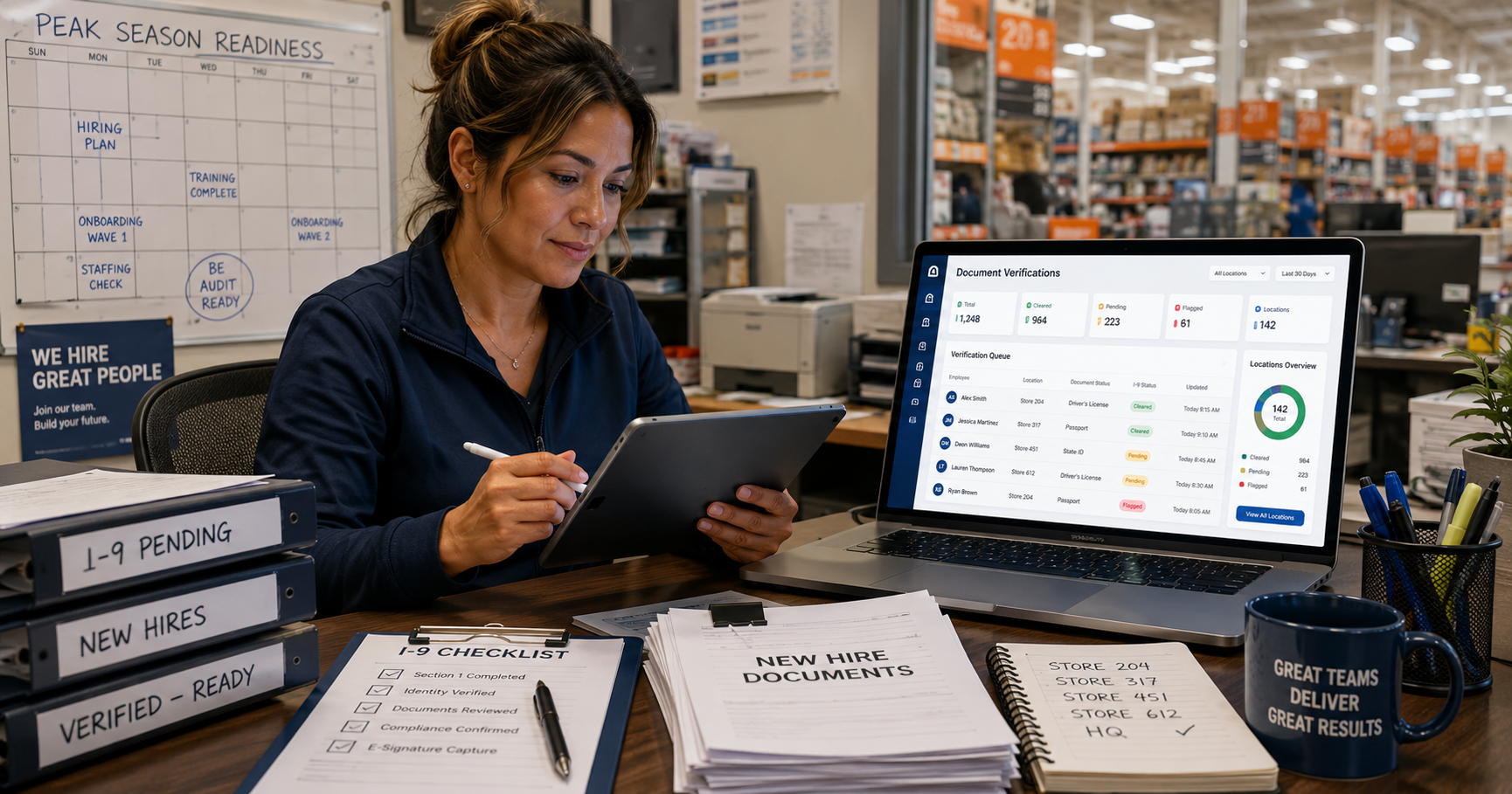
Hiring Compliance Guide For Retailers
Retail operates on a different timeline. Unlike most industries, retail stores face predictable, and sometimes unpredictable, hiring surges: holiday season, back-to-school, new store openings, Black Friday staffing.
Each one requires rapid hiring and verification, yet I-9 deadlines don't change. Employers still have 3 business days to complete each form and verify documents, then must keep the form ready for an audit.
For multi-unit retailers, the result is a compliance squeeze. While store managers scramble to staff up during peak seasons, HR teams struggle to keep verification consistent across hundreds of locations, all while facing ICE audit risk and newly tightened penalties.
In this guide, we explain the I-9 compliance requirements retail hiring managers must follow, why seasonal hiring creates compliance bottlenecks, and how AI-powered document intelligence helps retailers verify employees faster without sacrificing consistency or audit readiness.
Key takeaways
- Every retail hire, including seasonal, part-time and temporary staff, needs a completed Form I-9, with Section 2 done within 3 business days of the first day of work.
- In March 2026, ICE reclassified many common I-9 errors as substantive violations, which carry immediate fines and no correction period.
- Substantive violations cost $288 to $2,861 per form.
- Document copies no longer make up for missing information in Section 2.
- With many managers verifying documents across many stores, inconsistency is one of retail's biggest audit risks.
- AI-powered document intelligence helps stores verify faster and apply the same standards everywhere.
Why retail I-9 compliance is different
The turnover problem
Retail has a turnover challenge. Bureau of Labor Statistics data shows retail's turnover rate running higher than the average across all industries year after year, so large retailers hire thousands of employees every year, many of them seasonal or part-time.
Every hire requires a completed Form I-9, every I-9 requires document verification, and every verification creates audit liability.
Seasonal hiring spikes create compressed timelines
Retail hiring isn't spread evenly across the year. Holiday season, back-to-school and store openings pack much of it into a few weeks, and that compression creates a compliance trap:
- Store managers hire dozens of seasonal employees in a short window
- HR has 3 business days to verify each employee's documents
- Multiple hiring channels (in-store, online, hiring events) create inconsistency
- Verification gets rushed or deferred, and errors slip through
When ICE audits, many errors that used to be routine mistakes now count as substantive violations with immediate fines.
Multi-location inconsistency creates audit exposure
A 100-store retailer may have 100 different people verifying I-9 documents. One store manager is rigorous and another is lenient; one flags a suspicious document and another approves it.
When ICE reviews I-9s from across the chain, those differences show up, and inconsistency signals poor oversight.
What are the I-9 requirements for retail employers?
Retail employers must complete Form I-9 for every new hire, whether seasonal, part-time or temporary, and complete Section 2 within 3 business days of the first day of work. The table below covers the core federal requirements.
| Requirement | What it means for stores | Deadline or obligation |
|---|---|---|
| Form I-9, Section 1 | The employee completes and signs Section 1. If a manager helps, they complete Supplement A as preparer or translator. | No later than the first day of employment |
| Form I-9, Section 2 | The employer or an authorized representative examines original, unexpired documents and records the title, issuing authority, number and expiration date. | Within 3 business days of the first day of work; by the first day if the job lasts under 3 business days |
| Acceptable documents (Lists A, B, C) | The employee chooses one List A document, or one List B plus one List C document. Managers can't ask for specific documents. | At the Section 2 examination |
| E-Verify (if enrolled) | The employer creates an E-Verify case from the completed Form I-9. | No later than the 3rd business day after the employee begins work for pay |
| Supplement B (rehire and reverification) | Records rehires within 3 years of the original form, and reverifies work authorization that has an expiration date. | On rehire, and by the date temporary work authorization expires |
| Retention | The employer keeps each form for 3 years after the hire date or 1 year after employment ends, whichever is later. | Produce forms within 3 business days of a Notice of Inspection |
| ICE inspections (March 2026 guidance) | Many common errors, including missing Section 2 document details and missing rehire dates, now count as substantive violations, even when document copies are on file. | No correction window; fines of $288 to $2,861 per form |
For full details, see the USCIS Handbook for Employers, the E-Verify process overview and USCIS guidance on Supplement B.
What changed in ICE's I-9 enforcement in 2026?
High turnover, distributed locations and seasonal hiring patterns mean retailers complete more I-9s than most employers, and every one of them can come up in an audit. Combined with ICE's March 2026 enforcement changes, that adds up to serious compliance risk.
Substantive violations now carry immediate fines
Until March 2026, ICE treated many common I-9 errors as technical violations: correctable mistakes with a 10-business-day correction period. On March 16, 2026, ICE updated its Form I-9 inspection fact sheet and reclassified numerous errors as substantive violations, with immediate fines and no correction window.
Errors that now count as substantive (fines of $288 to $2,861 per form under 8 CFR 274a.10) include:
- Missing employee birth date, or a missing date next to the employee's signature, in Section 1
- Missing first day of employment, or a missing title for the person completing Section 2
- Missing or incomplete document information (title, issuing authority, number, expiration date) in Section 2
- Failure to check the alternative procedure box when the employer examined documents remotely
- Missing preparer or translator information in Supplement A
For a retailer with 500 new hires and a 10% error rate, that means 50 forms with substantive violations, or $14,400 to $143,050 in immediate fines, with no chance to correct them first.
Retail is particularly vulnerable because:
- High-volume hiring means more forms, and more chances for errors
- Seasonal hiring pressure leads to rushed verification
- Multi-location inconsistency compounds the problem
- Store managers handle I-9s on top of running the store
Document copies are no longer a safety net
Retailers have long kept copies of employee documents as backup when Section 2 entries were incomplete. Under the March 2026 guidance, the practice no longer protects them.
ICE now treats incomplete List A, B or C information in Section 2 as a substantive violation, even when the employer kept document copies. The form itself must be complete.
How AI document intelligence helps with retail I-9 compliance
Instead of store managers manually keying in and checking every document during peak season, AI-powered document processing (AI-IDP) extracts key information from each document, flags missing fields and discrepancies, and checks for signs of fraud. Store managers still examine the documents and sign Section 2, but they spend far less time on data entry and checks.
Faster verification at peak. Automated data capture and checks cut the time each verification takes, so store managers can keep up with the 3-day deadline even when dozens of new hires join in the same week.
The same standards at every store. Centralized, AI-powered verification applies the same checks at every location, so results don't depend on which manager is on shift. Consistency is documented and audit-ready.
Reverification for seasonal rehires. When a seasonal employee returns the following year, the system flags whether reverification is needed and prompts HR to complete it before the employee's first day back.
A complete audit trail. The system logs every verification, decision, flagged document and exception with a timestamp and user, so when ICE audits, HR can pull a complete compliance record for any employee.
Lightico's AI-IDP and ID Verification bring these steps together, and our post on how document intelligence and identity verification are converging explains how the two work together.
Lightico customers in other regulated industries use the same approach. Exeter Financial Services cut its customer welcome process from 14 days to 5 minutes, with a 95% completion rate and $1.19 million in savings.
Retail needs faster, more consistent verification
Retail faces a unique compliance challenge: high-volume hiring, seasonal spikes, multi-location operations and stricter penalties. Manual I-9 processes can't keep up with peak season demands while staying consistent and audit-ready.
AI-powered document verification allows retailers to:
- Verify faster during holiday season and peak hiring periods
- Catch fraud that manual review can miss
- Maintain consistency across all store locations
- Reduce audit risk with complete, defensible documentation
- Scale hiring without scaling the compliance burden
FAQ
What documents can seasonal employees present for I-9 verification?
Seasonal employees follow the same document rules as every other hire. They present documents from one of three USCIS lists: List A establishes both identity and work authorization (for example, a U.S. passport or Permanent Resident Card), List B establishes identity only (for example, a state driver's license), and List C establishes work authorization only (for example, an unrestricted Social Security card). Store managers can't specify which documents employees bring.
How do we handle I-9 verification during holiday hiring season when we're onboarding 500+ employees in 2 weeks?
Manual document review struggles to keep up with holiday-season volumes, and that's when stores fall behind on the 3-day deadline, defer verification, or rush the process. Retailers with high-volume seasonal hiring should use automated document verification that extracts and checks document details quickly, flags suspicious documents for manual review, applies the same standards at every store, and keeps audit-ready records automatically.
What's the penalty if we miss the 3-day I-9 deadline?
Completing Section 2 on day 4 or later is a paperwork violation, and substantive violations carry fines of $288 to $2,861 per form with no correction period. For a retailer that onboards 100 seasonal employees and misses the deadline on 10 of them, that could mean $2,880 to $28,610 in fines. If you find a late form, complete it right away and date it accurately. Never backdate it.
How do we keep I-9s consistent across 50+ store locations when each store manager verifies documents differently?
Consistency is one of the biggest compliance risks for multi-unit retailers, because uneven forms across stores signal poor oversight during an ICE audit. Give every store the same Section 2 checklist and training, send flagged documents to a central HR team, and audit forms regularly. AI-powered document verification helps by applying the same checks at every location and keeping a record of every decision.
How do we manage reverification for seasonal employees who are rehired annually?
Track work authorization expiration dates and rehire dates for every seasonal employee. If you rehire someone within 3 years of the date on their original Form I-9, you can complete Supplement B instead of a new form. After 3 years, they need a new Form I-9. If their work authorization has expired, reverify it before their first day back. A missing rehire date in Supplement B is now a substantive violation.
How long must we keep completed I-9 forms for retail employees?
Keep each completed Form I-9 for 3 years from the date of hire or 1 year from the date employment ends, whichever is later. For most seasonal employees who work a single season, that means 3 years from the hire date. Store forms in a central system so you can produce them within 3 business days of an ICE Notice of Inspection.
About Lightico
Lightico is an AI-powered customer journey orchestration platform that helps enterprises automate identity verification and document processing at scale. With AI-IDP and IDV capabilities, Lightico helps retail employers reduce manual I-9 document review, detect document forgery early, verify employees faster during peak hiring seasons, and maintain audit-ready compliance documentation across all store locations.
For multi-unit retailers managing high-volume, high-turnover hiring with compliance risk, Lightico provides a proven solution. Schedule a demo to see how Lightico can reduce your I-9 verification burden and improve hiring compliance across your stores.

