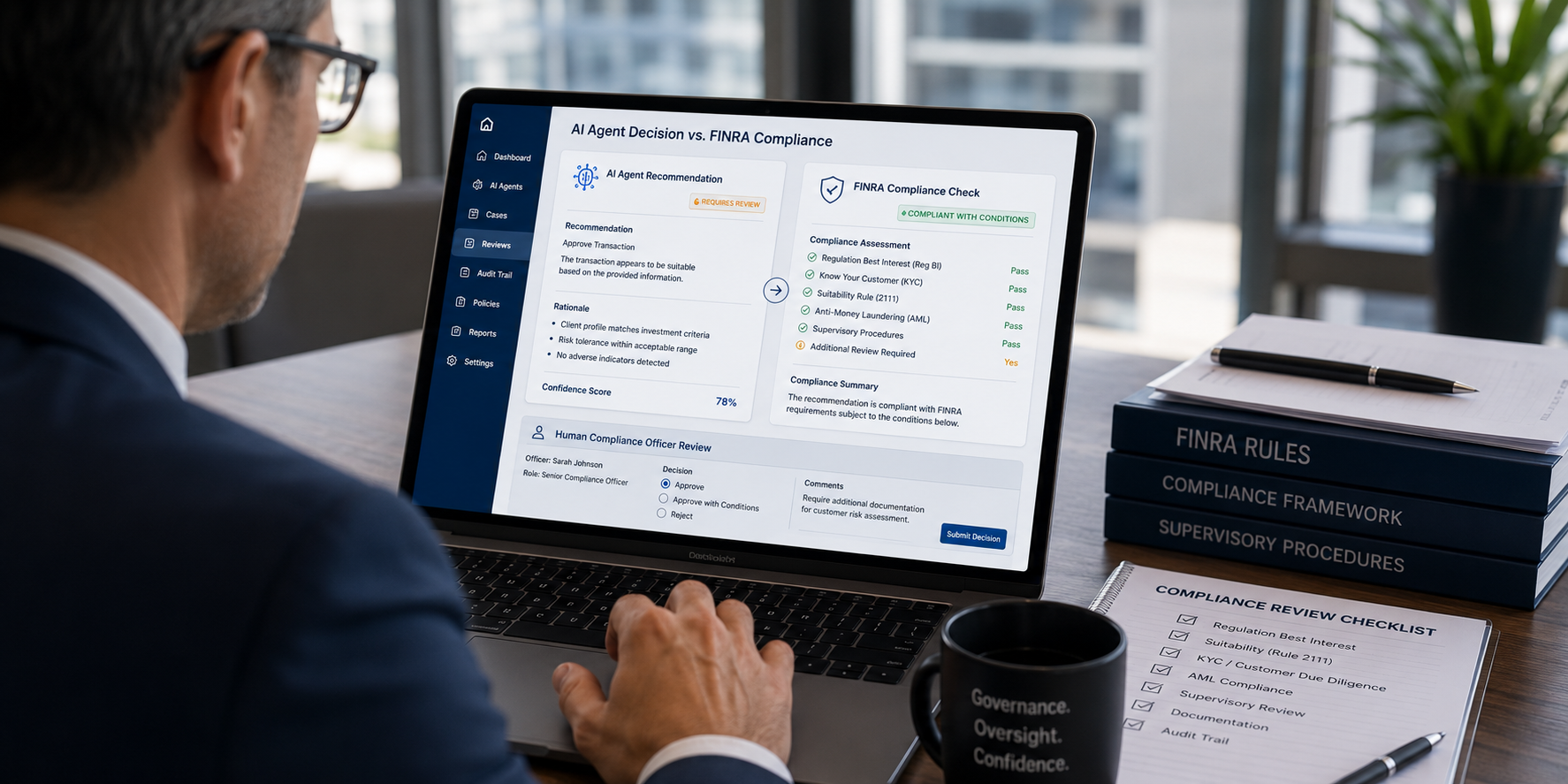
FINRA's 2026 Agentic AI Classification: What Banks and Lenders Need to Know
In its 2026 Annual Regulatory Oversight Report, FINRA took a significant step. It moved agentic AI from "emerging technology" to "active supervisory priority."
What's New? The formal classification:
FINRA identified AI agents as systems capable of autonomously interpreting objectives, taking multi-step actions, and adapting dynamically to changing environments. More importantly, FINRA classified them as a distinct supervisory risk category. This means examiners now have a formal framework for evaluating agent governance. This classification is not advisory. It signals that examiners will be asking about agent governance during upcoming examinations, and non-compliance will result in citations.
The Four Risk Vectors FINRA Identified:
- Agents acting without human validation: AI systems that initiate transactions or decisions without a human reviewing them in real time.
- Scope and authority exceeding user intent: Agents that access systems or data beyond their designed scope, or that escalate beyond their authorization boundaries.
- Auditability challenges in multi-step reasoning chains: Agents that make decisions through complex reasoning paths that can't be explained or traced.
- Potential misuse of sensitive client data: Agents with access to PII, account data, or transaction history that could theoretically be compromised or misdirected.
Clarifying the AI Landscape: Generative vs. Agentic AI
FINRA's classification focuses specifically on agentic AI—systems that take autonomous action. This is distinct from generative AI, which produces content (summaries, drafts, analysis) but doesn't execute decisions without human approval. A bank using ChatGPT for draft communications reports is using generative AI. A bank using an AI system that autonomously approves loans or routes payments is using agentic AI. FINRA's 2026 governance mandate applies primarily to agentic systems, though generative AI governance is also expected. The key difference: generative AI outputs content; agentic AI outputs action. Actions require governance; content requires oversight.
Is your bank prepared for FINRA's agentic AI examination?
Get Your Examination Readiness Assessment
Find out how your agent governance framework compares to FINRA's expectations in just 30 minutes.
Agent Governance Reality Check: Why Most Banks Are Non-Compliant
A Chief Compliance Officer at a regional bank is reviewing her institution's loan approval system. A piece of automation has been running for several years. It takes loan applications, evaluates them against underwriting criteria, and routes them to the appropriate lender or flags them for manual review. It processes hundreds of applications daily. It's profitable. It works.
Then she reads the section in FINRA's 2026 Annual Regulatory Oversight Report titled "AI Agents as a Supervisory Risk Category," and realizes: the system she's been running isn't just a workflow automation anymore. It's an "agent," according to FINRA's new taxonomy. And that changes everything.
She pulls her audit logs. They're incomplete. She checks her human oversight design. It exists, but it's not documented the way regulators expect. She asks her team: "If an examiner came in and asked why this agent approved a specific loan, could we explain the full chain of reasoning—including how we verified the applicant's identity and the supporting documents?" The room goes quiet.
This scenario is playing out at dozens of banks and lenders right now. Most deployed agentic systems 2 to 4 years ago, before AI governance was a regulatory priority. Now, with FINRA's formal classification, the rules have changed retroactively.
How Agentic AI Changes the Compliance Game for Banks
Previous FINRA and Federal Reserve guidance on AI focused on model risk management: things like bias, accuracy, training data documentation. Those frameworks treated AI as an analytical layer, not an autonomous actor.
Agentic AI is different. An agent doesn't just make a recommendation; it takes action. It initiates transfers, approves applications, escalates cases. That autonomy introduces new failure modes and regulatory risk that traditional model-risk frameworks don't capture.
But there's a critical nuance that many banks miss: an agent's governance is only as strong as its input controls. A loan approval agent that can explain its reasoning perfectly is still non-compliant if the income documents it relied on were processed incorrectly, or if the applicant's identity was never verified. Downstream transparency without upstream control is a governance illusion.
FINRA's classification signals that regulators now expect banks and lenders to govern agents differently than they govern recommendation engines or analytical tools, and to control the data flowing into those agents.
Agentic AI Compliance Risk: What Banks Face in 2026 Examinations
FINRA Examination Readiness: What Examiners Will Ask About Agent Governance
FINRA's 2026 classification signals that examiners will be asking about agent governance in upcoming examinations.
When an examiner sits across from your Chief Risk Officer and asks, "Walk me through your governance framework for your loan routing agent," here's what they're listening for:
- Human oversight: Is there an explicit checkpoint where a human can review or override the agent before it takes action?
- Audit trail: Can you pull up any agent decision from the past 3 years and show exactly what happened, why, and who was involved—including what documents and identity verification the agent relied on?
- Scope documentation: What data can this agent access? What systems can it touch? How do you enforce those boundaries?
- Permission enforcement: Is the agent restricted to what it was designed to do, or can it escalate itself or access unrelated systems?
- Input validation: How do you know the documents and identity data the agent is using are genuine and correctly processed?
If you can answer these clearly (including the upstream document and identity controls), you pass. If you fumble—if your audit trails don't show document processing steps, if identity verification is manual and inconsistent, if scope is implied rather than explicit—you get a violation citation. The best case is a remediation order. The worst case is enforcement action.
Shadow AI: The Governance Blind Spot
One often-overlooked compliance gap is "shadow AI"—unapproved AI tools that employees adopt informally for productivity. A loan officer using ChatGPT to summarize financial documents without logging it. A compliance analyst using an unauthorized tool for bias testing. A credit team member using a generative AI tool for draft correspondence. These uses fall outside governance frameworks because they're informal, undocumented, and invisible to compliance.
FINRA's 2026 report expects firms to inventory ALL AI use—approved and informal—and establish clear policies governing which tools are acceptable and which are prohibited. An agent governance framework focused only on formal, approved systems while shadow AI proliferates leaves material risk uncontrolled. Best practice: conduct a comprehensive AI audit that asks employees directly which tools they're using, document all findings, and establish policies that either approve tools with controls or prohibit them entirely.
Agent Governance Retrofitting: Timeline, Cost, and Compliance Requirements
Most banks and lenders that have deployed agentic systems did so without the governance framework FINRA now expects. This creates a retrofit challenge.
Current state at most large lenders:
Agents were deployed 2 to 4 years ago, when AI governance meant "have a data scientist review model performance." Audit logs exist but are incomplete (input/output only; they don't show the full reasoning chain, or the document processing and identity verification steps that fed the decision). Human oversight is documented but not architected into the workflow. Humans review after the fact, not before action. Document processing is often manual or uses legacy OCR tools that don't feed into audit trails. Identity verification happens separately from agent orchestration, making it invisible to compliance auditors. Permission boundaries are implied (the agent "knows" it shouldn't access certain systems, but this isn't enforced by the platform).
To retrofit compliance:
Redesign agent workflows to include human checkpoints before material actions. Implement complete, query-level audit logging that captures document processing steps (which docs were reviewed, what was extracted, what risk indicators were flagged). Ensure identity verification steps are logged and traceable. Integrate document processing and identity verification into the agent orchestration layer, not as separate systems. Document and enforce permission boundaries. Create impact assessments and governance documentation for regulatory files.
Estimated costs vary widely depending on system complexity, current audit trail capability, and whether document processing and identity verification are already in place. A preliminary audit typically takes 2 to 4 weeks and will clarify the scope and budget of your remediation effort.
This is not a small project. It's a structural rebuild of how you handle automation, and it requires integrating document processing and identity verification as first-class components of agent governance, not afterthoughts.
First-Mover Advantage: Why Banks Moving Now Will Pass FINRA Exams
Here's what's often missed: The banks and lenders moving fastest right now are building competitive advantage.
The lenders that move in the coming months can:
- Pass FINRA examinations with documented compliance—including full traceability of documents and identity verification
- Avoid enforcement actions that damage institutional reputation
- Set their governance baseline before the next wave of regulation hits other agencies
- Position compliance as a differentiator in customer relationships (larger enterprises increasingly require vendors to demonstrate end-to-end AI governance)
The lenders that move after preparing governance frameworks are retrofitting under pressure, facing higher costs, and potentially dealing with regulatory citations.
Most banks wait until they're behind. Don't be one of them.
Talk to Institutions Already Doing This
See how other banks and lenders are building governance frameworks that pass FINRA examinations.
5-Step Agent Governance Framework Compliant Banks Use
The banks and lenders that are moving fastest aren't waiting for enforcement. They're auditing their systems now and rebuilding governance from the ground up. Here's the pattern they're following.
Step 1: Audit and Classify Agent Systems
The first step is simple but essential: document what you actually have.
Compliant lenders are conducting an inventory:
- Which systems are agents? (i.e., which ones make decisions AND take action without human intervention in between)
- Which agent systems are high-risk? (i.e., which ones affect customer funds, credit decisions, account access, or compliance classifications)
- What's their current audit trail capability? (complete decision chain, or just input/output?)
- What's their human oversight design? (architected into the workflow, or bolted on?)
- What document processing feeds this agent? (are income/employment docs extracted and verified, or is it manual and ad hoc?)
- What identity verification precedes this agent? (is applicant identity confirmed before the agent processes the application?)
Why this matters: Many banks and lenders discover that systems they thought were "workflow tools" are actually agents by FINRA's definition. A rules engine that auto-approves applications under a certain threshold is an agent. A payment router that automatically selects a routing path and initiates transfer is an agent. An AML screening system that auto-flags accounts is an agent.
Critically, they also discover that their document processing is invisible to compliance auditors (no logs), and identity verification happens in a separate system that the agent doesn't "see." This fragmentation is a compliance red flag. FINRA will ask: "Show me the full chain from applicant submission through identity verification, document processing, agent decision, and human review." If the chain is broken into separate systems with no integrated audit trail, you've got a remediation problem.
Once classified, lenders can prioritize: which agents affect the most customers or the most risk, and should be retrofitted first? And critically: which agents lack proper upstream document and identity controls?
Step 2: Architect Human Oversight Into the Workflow
The compliance difference between "agent with human oversight" and "compliant agent" is subtle but critical.
Non-compliant approach:
Agent processes transaction or decision. Agent logs the output. Batch of decisions reviewed by humans (daily, weekly, or monthly). Humans can override decisions after the fact. FINRA's view: Human oversight is too far downstream; by the time humans review, the action has already been taken.
Compliant approach:
Agent processes transaction or decision. Agent identifies if decision is "material" (affects customer funds, credit, account status, compliance). If material: agent pauses and surfaces decision for human review before taking action. Human reviews the full context (documents processed, identity verification completed, agent reasoning, risk flags), approves, rejects, or escalates. Only after human approval does the agent take action. All human touchpoints logged with timestamp, reviewer ID, decision. FINRA's view: Humans are in control; they review the complete picture before the agent acts.
Implementation example:
Banks and lenders doing this are redesigning workflows like this:
1. Application received
2. Identity verification: Confirm applicant is who they claim to be
3. Document processing: Extract and verify income statement, employment letter, etc.
4. Agent extracts cleaned data, evaluates against criteria
5. System tags decision as "Approve" or "Deny"
6. Is this decision material?
   YES: Flag for human review (STOPS HERE)
   NO: Proceed to auto-action (e.g., send pre-approval email)
7. Human reviews flagged decision (sees documents, identity verification, agent reasoning)
   Approves: Agent executes decision (send approval letter, fund transfer, etc.)
   Rejects: Human overrides decision, agent executes override
8. All steps logged with timestamps and reviewer ID
The key difference: the agent doesn't act until a human has explicitly approved the full context, not just the agent's logic.
Step 3: Build Complete, Queryable Audit Trails
This is where most banks and lenders struggle. Their current systems log data, but not in the way FINRA expects.
What "complete" means:
A complete audit trail for a single agent decision should capture:
- Identity verification step (which verification method, confidence level, timestamp)
- Document processing step (which docs submitted, extraction confidence, risk flags)
- What triggered the agent (user action, API call, scheduled event, system alert)
- What data the agent accessed (which customer records, which data fields, timestamps)
- What the agent decided (yes/no, approve/deny, flag/clear)
- The reasoning chain (confidence score, which rules fired, which decision tree path was followed, if the model was updated recently)
- Uncertainty metrics (how confident was the agent? Were there edge cases?)
- What the agent proposed to do (transfer funds, approve loan, flag account, etc.)
- Who reviewed it (human reviewer ID, timestamp)
- The human decision (approved the agent's decision, overrode it, requested more information, escalated)
- Final outcome (decision ID, timestamp, audit log ID)
Why this is hard: Most banks and lenders have document processing, identity verification, and agent decision-making scattered across multiple systems. The loan origination system logs one thing, the document processing tool logs another, the identity verification service logs a third, the agent logs a fourth. Tying them together into a single coherent "decision chain" requires engineering work.
What compliant lenders are doing: Building a unified audit logging layer that captures every decision point—including document processing and identity verification—in a single queryable database. When a regulator says "show me the full chain for this decision," they can pull decision ID ABC-123 and see the entire journey (identity check → document processing → agent decision → human review → outcome) in seconds.
Oliver Wyman research found that automating up to 70% of manual compliance work can improve risk detection accuracy by as much as four times. But this only works when the automation is fully auditable and integrated. Audit trails that span document processing, identity verification, and agent decision-making are the evidence that the automation is working right.
Step 4: Test and Document for Bias
FINRA's mandate on bias is implicit but clear: agents should not produce systematically unfair outcomes for protected groups.
Compliant lenders are running monthly or quarterly discrimination tests on their agent decisions:
What they're testing:
- Approval rates by race, ethnicity, national origin, gender, age, disability (to the extent data permits)
- Interest rates or fees offered by cohort
- Denial reasons by cohort (are certain groups denied for different reasons?)
- Document processing accuracy by cohort (does the AI-IDP extract income data equally well for all groups?)
- Identity verification success rates by cohort (does IDV work equally well across different document types and geographies?)
Benchmark: The "4/5 rule" from Fair Lending law. If approval rate for one group is less than 80% of another group's rate, it signals potential discrimination.
What they're documenting:
- Test date, methodology, findings
- If discrimination is found: what the root cause is (agent bias? document processing error? identity verification issue?) and what mitigation steps are being taken
- Whether the model needs retraining, or whether decision-tree thresholds need adjustment, or whether document processing or identity verification calibration is needed
This documentation is critical for two reasons: (1) it shows FINRA you're monitoring for bias across the full decision chain, and (2) it becomes evidence in your defense if a consumer alleges discrimination.
Step 5: Create Governance Documentation for Regulators
Based on FINRA's stated focus on human oversight, audit trails, and scope documentation, lenders should prepare governance documentation including:
- Impact assessment: What is this agent? What risk does it pose? What upstream controls (identity verification, document processing) feed it?
- Architecture diagram: Shows identity verification, document processing, human checkpoints, data access, scope boundaries
- Audit trail samples: 3 to 5 example decisions with full decision chains (including identity and document processing steps)
- Bias testing results: Monthly or quarterly discrimination tests across the full workflow (agent, documents, identity verification)
- Governance framework: Who approves changes to the agent, document processing, or identity verification? When do you retrain? What triggers a review?
- Change log: Every update to the agent, documents, or identity verification, with approval dates and testing results
Having this organized and readily available will help lenders pass examinations faster than those that have to scramble to assemble it.
Ready to implement this framework?
Our team can help you assess your current state against these five steps and map your remediation timeline.
How Lightico Enables Complete Agent Governance
Banks and lenders that understand the full scope of agent governance—including upstream document processing and identity verification—are turning to purpose-built platforms that integrate all three layers in a single orchestration engine.
The integration problem: Most banks bolt together separate tools: an agent orchestration platform, a document processing tool, an identity verification service. This creates fragmentation in audit trails, inconsistent governance, and complexity during compliance reviews. When an examiner asks to see the full chain from applicant submission through decision and execution, you end up reconstructing it from logs spread across three systems. That's a compliance liability.
What integrated platforms do: Purpose-built platforms for regulated industries bundle agent orchestration, document processing (AI-IDP), and identity verification (IDV) into a single integrated system. This means:
- Unified audit trail: One queryable log captures identity verification, document processing, agent decision, and human review in sequence. Examiners see the complete chain with one request.
- Built-in compliance controls: Document processing and identity verification aren't afterthoughts; they're native to the orchestration engine. You don't custom-engineer governance on top of fragmented tools.
- Faster deployment: Around 90 days vs. 9+ months stitching together separate systems and writing custom integration code.
- Reduced operational complexity: One platform to audit, one set of controls to manage, one compliance narrative for regulators.
Lightico's approach: Lightico is purpose-built for regulated industries (banks, auto finance, financial services) and provides SOC 2 certification. The platform integrates three core capabilities:
- Agentic AI for customer journey orchestration: Agents that make decisions (approve loan, flag fraud, route payment) with full human oversight and audit trails
- AI-IDP (Intelligent Document Processing): Extracts data from income statements, employment letters, and other compliance documents with configurable risk indicators (e.g., "flag if extraction confidence is below 85%")
- IDV (Identity Verification): Detects identity fraud, biometric spoofing, and account takeover before agents process applications
These three capabilities work together. An agent's decision is only as good as the documents and identity verification it relies on. By integrating them, Lightico ensures that governance is complete—from input verification through decision-making through human review through execution. The audit trail is unified, the compliance narrative is clear, and the examination-readiness timeline is measured in months, not years.
Alternative approaches: Banks can build this integration in-house. It's technically feasible. It's also expensive (estimated 8-12 months of engineering time), risky (custom code has bugs), and creates ongoing maintenance burden. Some banks choose this path when they have existing legacy systems they can't replace. But for greenfield projects or major upgrades, integrated purpose-built platforms reduce time to compliance, lower risk, and lower total cost of ownership.
The decision tree is simple: if you have existing systems you must preserve, build custom integration. If you're scoping a new governance platform, evaluate purpose-built solutions designed for regulated finance. Lightico is one example; there are others. The key differentiator is whether the platform integrates document processing, identity verification, and agent orchestration natively, or if you'll be bolting them together yourself.
5 Agent Governance Mistakes That Will Fail FINRA Examination
Mistake #1: "Our Agent Isn't High-Risk Because It's Just Routing"
Reality: If an agent makes a decision that affects customer outcomes, it's high-risk.
Example: A lender deploys an agent that routes loan applications to different lenders based on credit score and income. They think, "It's just routing; the lenders make the actual approval decision."
FINRA's view: The routing agent materially affects customer outcomes. If the agent consistently routes high-income applicants to better-rate lenders and low-income applicants to worse-rate lenders, the agent is making a discriminatory decision, even if downstream lenders also have input.
Lesson: Don't assume your agent is low-risk based on what it's nominally designed to do. Think about how customers experience it. Does it affect their access to financial services? If yes, it's high-risk.
Mistake #2: "We Tested for Bias Once During Development; That's Enough"
Reality: Bias can emerge over time as new data flows through the system.
Example: A bank trains a loan approval agent and runs discrimination tests. Everything looks good. Six months later, the model has seen thousands of new applications. A new cohort-based bias has emerged (say, the model now slightly penalizes applicants in certain zip codes), but the bank hasn't retested. Meanwhile, document processing accuracy drifts (income extraction confidence drops for certain document formats), and identity verification success rates diverge by geography. None of this is caught because testing stopped after launch.
Research from Wolters Kluwer shows that 44% of finance teams will use agentic AI in 2026, representing an increase of over 600%. But most lack continuous monitoring frameworks—including monitoring of document processing and identity verification, which are often treated as utilities, not as part of the AI governance story.
Lesson: Bias testing is not a one-time event. It's an ongoing practice that includes the full stack (agent, documents, identity). At minimum, quarterly testing. Better: monthly. And it should span agent decisions, document processing accuracy, and identity verification consistency.
Mistake #3: "Human Oversight Means Humans Review the Decision Afterward"
Reality: FINRA expects humans to be in the decision flow, not reviewing after action.
Example: A lender deploys a payment agent that autonomously initiates transfers under $10K. At the end of the day, humans review the log of all transfers made. This is after-the-fact review.
FINRA's expectation: Material decisions should be reviewed before the agent takes action, not after. And that review should include visibility into the documents and identity verification that fed the decision.
Lesson: Redesign workflows to put humans in the flow. Make "material decisions" pause for human approval before execution. And make sure humans have visibility into upstream controls (document processing, identity verification) so they can make informed decisions.
Mistake #4: "Our Document Processing and Identity Verification Are Separate Systems, So They Don't Matter for Agent Governance"
Reality: Fragmented document and identity controls create compliance blind spots.
Example: A bank has an agent that approves personal loans. It has document processing in one system (extracts income data), identity verification in another (confirms applicant identity), and the agent in a third. Each system has logs, but they don't connect. When compliance tries to audit a specific loan decision, they have to reconstruct the chain from three separate logs. And they discover that document processing confidence was 72% (below their stated threshold of 85%), but the agent processed it anyway because it didn't "see" that flag. And identity verification happened in a system the agent can't query, so no one knows if it actually ran.
FINRA will ask: "Show me why this loan was approved." Your answer: "The agent decided yes, documents were processed, and identity was verified" sounds complete. But if you can't show those steps in a unified audit trail, regulators will ask harder questions.
Lesson: Document processing and identity verification aren't separate from agent governance—they're foundational to it. They need to be integrated into your audit trail and visible to agents (so agents can act on risk flags) and to examiners (so they can see the complete decision chain).
Mistake #5: "We Don't Need to Disclose AI Use to Customers Because It's Internal"
Reality: Customers have a right to know when AI materially affects their financial access.
Example: A bank denies a loan based partly on an agent-driven fraud assessment that flagged the applicant's identity as potentially spoofed. They don't tell the customer that AI (specifically identity verification AI) was involved. Customer sues, alleging algorithmic bias. Bank has no defense—and now faces disclosure violations on top of the substantive claim.
Lesson: Transparency is part of governance. When AI materially affects a customer (approval, denial, rate)—whether it's agent decisions, document processing, or identity verification—they should know.
How many of these mistakes is your bank making right now?
Assess Your Agent Governance Risk
A 30-minute conversation can reveal which governance gaps pose the highest examination risk.
Agent Governance FAQ for Banks: FINRA Compliance Questions Answered
Q: What Is FINRA?
A: FINRA (Financial Industry Regulatory Authority) is a self-regulatory organization that oversees US broker-dealers, investment advisors, and securities firms. It operates under the authority of the SEC and has regulatory power equivalent to a government agency.
What FINRA does:
- Conducts examinations of member banks and lenders
- Issues enforcement actions, fines, and sanctions
- Sets rules for how financial institutions operate
- Focuses on market integrity, customer protection, and operational risk
Why FINRA matters for agentic AI: If your bank or lending platform is regulated by FINRA (virtually all US financial institutions are), you must comply with FINRA rules. In 2026, FINRA formally classified AI agents as a distinct supervisory risk category. This means examiners will ask about agent governance in upcoming examinations. Non-compliance equals citation or enforcement action.
Who's regulated by FINRA:
- US banks and thrift institutions
- Broker-dealers and investment firms
- Captive auto lenders and other financial services platforms
- Fintech lending platforms serving US customers
- Insurance companies with securities or investment operations
Q: When Does FINRA Start Enforcing This?
A: FINRA's 2026 report sets the expectation, which means:
- Q2 to Q3 2026 (now): Examiners will ask banks and lenders about agent governance during examinations
- Q4 2026 to Q1 2027: Enforcement actions on firms with non-compliant agent governance are likely to follow as examiners complete their examination cycles
- 2027+: Enforcement becomes routine; compliance is expected
There's no official "enforcement date," but the precedent is being set right now. If your bank or lender is examined in the next 6 months, examiners will ask about your agent governance framework. If you can answer clearly, you pass. If you can't, you get a violation.
Q: Do I Need Human Approval for Every Single Agent Decision?
A: Practically, no. FINRA expects human oversight at "material" decision points. These are decisions affecting customer funds, account status, credit decisions, or compliance classifications.
Example: A payment agent that routes transactions under $1,000 might not need human approval if your governance framework says "pre-approved below $1K threshold, human review for exceptions." FINRA wants to see that logic documented.
The key is: you define the rules, you enforce them consistently, and you can explain them to examiners.
Q: If I Buy a Third-Party AI Platform, Am I Still Liable?
A: Yes. Regulators hold the bank or lender accountable, not the vendor. The vendor can help you stay compliant (via audit trails, transparency, governance documentation), but they can't absorb your liability.
Before signing a contract with any vendor, ask:
- Can you provide complete audit trails of agent decisions—including document processing and identity verification steps?
- Can you enforce role-based access controls at the journey level?
- Do you have native human oversight gates architected into workflows, or do I need to custom-engineer them?
- Do you integrate document processing (AI-IDP) and identity verification (IDV) natively, or will I be bolting together separate systems?
- Can you provide governance documentation for regulatory examination?
- Do you have SOC 2 certification for regulated environments?
If a vendor can't answer these clearly, they're not ready for FINRA-regulated use.
Example of a compliant vendor: Lightico is purpose-built for regulated industries (banks, auto finance, financial services) and provides SOC 2 certification. Their platform integrates agent orchestration, AI-IDP (document processing), and IDV (identity verification) into a single governance engine. Audit trails are unified—identity verification, document processing, agent decision, and human review all appear in one queryable log. This eliminates the fragmentation that trips up most banks. Deployment is around 90 days, vs. 9+ months stitching together separate tools. Many lenders use purpose-built platforms like Lightico specifically because they reduce the engineering lift required to meet FINRA's governance expectations and avoid the compliance risks of bolted-together systems.
Q: What's the First Step We Should Take?
A: Conduct an audit of your automation systems:
- List all systems that make decisions and take action autonomously (agents)
- Classify them by risk level (high-risk equals affect customer funds or credit; medium-risk equals affect account features; low-risk equals advisory or non-consequential)
- For high-risk agents, assess:
- Are audit trails complete and integrated, or are they scattered across multiple systems?
- Is human oversight architected into the workflow, or bolted on?
- Can you trace the documents and identity verification that fed the agent decision?
- Can you explain your permission boundaries?
- Have you tested for discrimination across the full stack (agent, documents, identity) in the past 12 months?
This audit should take 2 to 4 weeks and will give you a clear picture of your compliance gap. From there, you can prioritize remediation and plan your timeline.
Q: How Can We Speed Up Compliance?
A: The banks and lenders that are moving fastest are using purpose-built orchestration platforms that integrate agent governance, document processing, and identity verification as native features. When these capabilities are architected together from the ground up, you can significantly reduce your time to compliance.
What this looks like: Unified audit trails that capture identity verification, document processing, agent decision, human review, and execution in a single queryable log. Human oversight gates that pause material decisions for approval before action, with full visibility into upstream controls. Role-based access controls that enforce scope boundaries automatically. All of this is queryable, documentable, and audit-ready out of the box.
Vendor evaluation framework: When evaluating AI governance platforms—whether Lightico or any vendor—treat them as high-risk vendors. Ask these critical questions:
- Data handling: What data does the platform collect, store, and retain? How is sensitive data protected?
- Audit trails and logging: What audit trails does the platform capture natively? Can it log identity verification, document processing, agent decisions, and human reviews in a single queryable system?
- Testing and monitoring: How does the vendor test for bias, hallucinations, and accuracy? Are there repeatable testing protocols built in?
- Contractual clarity: What guarantees exist around data security, retention, compliance, and regulatory defensibility?
- Access controls: Can the platform enforce role-based access and scope boundaries automatically?
- Certification: Does the vendor provide SOC 2 certification or equivalent for regulated environments?
- Integration capability: Does the platform integrate document processing, identity verification, and agent orchestration natively, or will you need to custom-build integrations?
These questions apply whether you're evaluating Lightico or competitors. The goal is ensuring your chosen platform reduces governance risk, not adds to it.
Lightico example: Lightico is purpose-built for regulated industries and deployed around 90 days. Their platform handles agent orchestration, document processing (AI-IDP), and identity verification (IDV) together, so you're not stitching together multiple tools or custom-building integration code. Because document processing and identity verification are native to the platform, they feed directly into agent logic and compliance logging. This significantly speeds your path to examination readiness, and you can generate governance documentation for regulators directly from the platform.
A preliminary governance audit will help you understand whether purpose-built solutions align with your remediation path and timeline. If your assessment shows significant engineering lift to retrofit existing systems or integrate fragmented tools, evaluating purpose-built governance platforms designed for regulated financial services should be part of your decision tree. The cost of building versus buying often comes down to timeline: buying (with integrated platforms) accelerates compliance; building (custom integration) takes longer but may be appropriate if you have existing systems you must preserve.
Why Agent Governance Is Non-Negotiable for Banks in 2026
FINRA's agentic AI classification is not a future concern. Examiners will ask about agent governance in upcoming examinations. Banks and lenders with compliant governance—including integrated document processing and identity verification—will pass examinations; those without will get citations.
The good news: governance is solvable. It requires redesigning workflows to put humans in control, building complete audit trails that span document processing through execution, ensuring identity verification is foundational, and documenting your framework. It's work, but it's not rocket science.
The banks and lenders that will thrive in the next 18 months are those that:
- Audit their agent systems now—including document and identity controls
- Prioritize high-risk agents first
- Architect human oversight into workflows, not around them
- Implement complete, queryable audit logging that spans document processing, identity verification, agent decision, and human review
- Start bias testing and monitoring across the full stack
- Build governance documentation for examiners
The banks and lenders that will struggle are those that wait for enforcement to be announced, or that try to retrofit governance under exam pressure, or that treat document processing and identity verification as separate from agent governance.
If you're running agentic systems in lending, payments, fraud detection, or compliance, and you're not sure whether your governance is FINRA-ready, now is the time to find out. An audit costs far less than a violation citation, and you'll get clarity on your remediation timeline and platform requirements.
The window to move proactively is now. After preparing governance frameworks, you're playing catch-up.
Your Agent Governance Roadmap: 4 Immediate Actions for Banks
If this resonates with your bank or lending platform, here's what we recommend:
- Audit your agent systems: List all automation that makes decisions and takes action. Classify by risk level. Identify governance gaps—including document processing and identity verification integration.
- Assess your remediation path: Determine whether to retrofit existing systems, rebuild, or use a hybrid approach. Understand scope and timeline. Evaluate whether fragmented document/identity tools can be unified, or if a purpose-built platform makes more sense.
- Talk to other institutions doing this: The compliance community is actively sharing patterns and lessons learned. Peer input is invaluable—especially on whether integrated platforms or custom integration is the right path.
- Evaluate governance platforms: If your assessment shows significant engineering lift, look at purpose-built orchestration platforms designed for regulated automation, document processing, and identity verification governance.
We're here if you want to discuss agent governance or learn how other banks and lenders are approaching FINRA compliance. Our team works with financial institutions on orchestration, document processing, identity verification, and compliance challenges daily. Lightico is purpose-built for regulated industries and provides SOC 2 certification. Let's discuss your specific situation.
Ready to move from uncertainty to clarity?
Let's talk about where you stand and what comes next for your bank's agent governance strategy.

